Thursday, December 29, 2011

Louisville Trinity's Quick honored again

Jody Demlng Recruiting Blog


Louisville Trinity High School junior wide receiver James Quick has picked up yet another national honor. He was named second-team All-American by Rivals.com.

Quick is considered the top college prospect in the Class of 2013 in Kentucky. He was the co-top vote-getter on The Courier-Journal’s All-State team.

He has also been named first-team All-American by ESPN.com and honorable mention by SI.com, while also being named a top 100 prospect nationally.

Quick and his fellow junior classmate at Trinity – defensive end Jason Hatcher – also picked up scholarship offers from Michigan this week.

The 6-foot-1, 185-pound Quick caught 82 passes for 1,434 yards and 21 touchdowns, averaging 17.5 yards a catch. He also ran for 136 yards and completed his only pass attempt for a 36-yard touchdown and had a kick return for a TD.

He also has scholarship offers from Louisville, Kentucky, Alabama, Arkansas, Illinois and Auburn.

Tuesday, December 27, 2011

LSU lands commitment from top-ranked ’12 QB Kiel

John Taylor

Gunner KielAP
Two months after pulling his commitment from Indiana and reopening his recruitment, Gunner Kiel has decided on a school a little bit further south than his original choice.
Kiel, the top-rated quarterback in the Class of 2012 according to Rivals.com, announced Tuesday evening that he’s flipping his non-binding verbal commitment to LSU, becoming the 22nd commit in the Tigers’ 2012 class.  Back in July, Kiel’s decision reportedly came down to the home-state Hoosiers and Alabama; this time around, Kiel chose the Tigers over Vanderbilt and Notre Dame.
“I woke up Friday morning and knew I wanted to be a Tiger,” Kiel toldMyIndianaFootball.com. “I can’t wait to be a Tiger.”
Kiel will graduate from Columbus (Ind.) East High School early and enroll in college in January, meaning he will be available to participate in spring practice.
With the expiring eligibility of both Jordan Jefferson and Jarrett Lee, Kiel will compete for the starting QB job with, among others, Zach Mettenbergerbeginning in the spring.  Mettenberger, a transfer from Georgia, will likely head into those sessions as the early favorite.
In addition to being Rivals‘ top-rated pro-style QB, the recruiting service also rates the 6-4, 220-pound Kiel as the No. 19 prospect at any position in the country.  As a senior this past season, Kiel threw for over 2,500 yards, ran for nearly 500 more and combined for 39 touchdowns — 28 passing, 11 rushing.
He had also received scholarship offers from, among others, Georgia, Michigan, Oklahoma, TCU, Tennessee, USC and Wisconsin
Dusty Kiel, one of the high schooler’s two older brothers, is a quarterback at Indiana.

Wednesday, December 21, 2011

Football Is Better Than Soccer

An Englishman Abandons the Beautiful Game for the NFL; Like a Chess Match—With Violence


By GERARD BAKER


Tampa Bay Buccaneers tight end Kellen Winslow carries a British flag onto the field before an Oct. 23 game at London's Wembley Stadium.

I'm a traitor. I may as well come straight out and admit it. I've betrayed my family, my friends, and my country. If Dante were around to update his roll-call of infamy, I'd be right down there in the ninth circle, feeling the heat with Brutus, Cassius and Judas.

The occasion of my sin isn't political or religious. It's much more grievous. I've betrayed my cultural heritage, cut the most binding filial ties, abandoned my national loyalties.

The shameful truth is this. I like football better than soccer.

I realized only recently the depth of my treachery when I found myself actually referring to football—the game played over here by the big men in spandex with the little oval ball—as "football." This alone would be considered a kind of verbal treason to my countrymen.

Growing up in England, I played football. I went to football games—with other football fans dressed in football attire at crumbling, violence-infested football stadiums that hosted teams with names like Charlton Athletic Football Club. (There was, confusingly, rugby football too, commonly called rugby, but I always hated that.)

"American football" (the term was usually enunciated in a sneering tone that dripped with derision, the way you might say "the Italian military") was something very silly, a far-off pastime of which we knew little and cared less, played by softies who apparently needed helmets and padding to protect their delicate frames.

If we ever thought about "American football" at all, we thought about all that protective gear and considered it a source of some pride that the average English football fan was in more physical danger on his way to the toilets (we called them that) at halftime than a roly-poly lineman in a scrimmage.

But I discovered football when I first came to New York in the late 1980s and my prejudices melted away. It was the era of New York Giants greatness and I was hooked instantly: Lawrence Taylor, Phil Simms, Mark Bavaro, Jeff Hostetler. Yes, I did just say Jeff Hostetler. That should tell you how hooked I was.

I didn't immediately abandon what I slowly came to call soccer. I'd keep in touch with the fortunes of my team, Coventry City (don't ask), every Saturday. But steadily, I lost interest. I'd find myself forgetting some weekends to check out the score on a Saturday in my sweat of anticipation for Sunday. I was drifting apart from family and friends.

There is no more powerful alienation than that of the displaced from his erstwhile peers. Every weekend I call my father back in London. At 91, he's as engaged as ever in events—sporting and otherwise. He wants to know what I think about Liverpool's latest signing. All I want to talk about is the 72-yard touchdown pass Victor Cruz caught from Eli Manning. He thinks Victor Cruz was a 1950s band leader (OK. I thought Victor Cruz was a 1950s band leader till the start of this season).

I'm desperate to find someone among my family or friends to compare notes on the remarkable success of the Houston Texans' third-string quarterback. My uncomprehending friends just shake their heads.

"Why?" they ask. How could you do this to us after all we did for you?

Some might say it's simply, predictably, a man's reaction to his habitat. If you're a sports nut and you move, you'll probably take up whatever's on offer in your new milieu. But that won't do as an explanation.

On that theory, if I moved to Canada I'd like hockey and I can assure you, that's not happening.

It's none of the usual explanations: lots of scoring being better than endless nil-nil draws—I've been to cricket matches in which 1,000 runs were scored and you could hardly call them riveting. It's not the hoopla or the sport-as-family-entertainment thing either which soccer fans accustomed to English hooliganism are supposed to appreciate. (Have you ever been to an Eagles game?)

Baseball fans will have to forgive me here, but the answer, I think, is that football is the quintessential American sport. It's no accident it hasn't really caught on elsewhere (the annual NFL game in London notwithstanding) whereas baseball and basketball have at least a claim to a global following and participation.

In its energy and complexity, football captures the spirit of America better than any other cultural creation on this continent, and I don't mean because it features long breaks in which advertisers get to sell beer and treatments for erectile dysfunction. It sits at the intersection of pioneering aggression and impossibly complex strategic planning. It is a collision of Hobbes and Locke; violent, primal force tempered by the most complex set of rules, regulations, procedures and systems ever conceived in an athletic framework.

Soccer is called the beautiful game. But football is chess, played with real pieces that try to knock each other's brains out. It doesn't get any more beautiful than that.

Monday, December 19, 2011

It's Official... Louisville Trinity #1

SI.com
On Aug. 5, three weeks before their season-opener, the Trinity (Ky.) Shamrocks held their annual green-and-white scrimmage. It's the same game played by countless programs nationwide, a glorified practice to gauge incoming talent. It's a way simulate game action, to test new additions to the playbook. In the course of a season, it means next to nothing.
This time, it was telling. Midway through the scrimmage, the defense called a safety blitz. As backup quarterback Blake Boughy prepared to give the ball to his running back, senior Adam Reynolds exploded through the line of scrimmage, snatching the ball out of Boughy's hands. He sprinted 15 yards to the end zone before anyone realized what had happened.
"I've never seen anything like that," said Bob Beatty, Trinity's 12th-year coach. "Everybody just kind of stood with their mouths open."
Over the next five months, the Shamrocks would evoke similar reactions. They went 14-0 to finish as SI.com's top-ranked high school team.
Their dominance was total. En route to a Kentucky Class 6A title -- Trinity's seventh consecutive crown and ninth since Beatty took over in 2000 -- it outscored opponents 697-116,outgaining them 6,397-2,822. It never trailed in the second half, and trailed just 12 minutes the entire year. However improbably, it improved in the playoffs: Trinity won five outings by an average of 50 points -- and set a new state record by putting up 62 in the final against Scott County (Ky.).
That's not a knock on its competition. Trinity foes went a combined 97-56, including two teams -- Indianapolis Central (Ind.) and St. Xavier (Ohio) -- that reached their respective state semifinals (Indianapolis Central won the Indiana Class 4A title).
"We had powerhouses nationally across the board," said quarterback Travis Wright. "Every week was a constant grind for us this year."
It didn't show. Led by the dynamic junior trio of Wright, running back Dalyn Dawkins (the nephew of Broncos cornerback Brian Dawkins) and wide receiver James Quick, the 'Rocks ripped through overmatched defenses in 2011. Wright notched a 70 percent completion percentage, and Dawkins rushed for 1,901 yards and 32 touchdowns. The aptly named Quick, a 6-foot-1, 180-pounder with offers to Alabama, Arkansas and Auburn, among others, reeled in 82 catches for 1,434 yards and 19 scores.
Despite their gaudy stats, Wright -- in typical quarterback fashion -- gave all the credit to his offensive line.
"A couple plays this season, if I wouldn't have had that half a second that I had to get the ball off, who knows what the outcome would've been," he said. "Our offensive line is definitely the reason we were so aggressive."
There was also their training regimen, a plan that would rival many BCS programs. The Shamrocks began weightlifting and speed drills as early as January, upping their commitment as the season wore on. During game weeks, players completed three and a half hours of football-related activities on Mondays, Tuesdays and Wednesdays, switching between on-field, film room and weightlifting sessions without break.
It didn't impede academics: Not one varsity starter missed time due to grade probation and Joey Shaw, a senior wideout, scored a perfect 36 on his ACT.
"The biggest thing these kids take from us is you have to punch the clock," said Beatty. "That's where you win games, and they understand that."
Finally, there was Beatty's impact, an influence that can't be overlooked. The coach and his staff spent nearly nine hours analyzing film on Saturdays, tirelessly preparing for the upcoming week's matchup. Their strategy was simple: Get the ball in the hands of playmakers, and let natural athletic ability do the rest.
"I'm very adamant that we don't need super complicated game plans," he said. "Let them not have to think. Any time people are thinking too much, it slows them down."
It worked brilliantly. Trinity scored 33 touchdown of 35 yards or longer -- 16 coming in the playoffs.
In fact, the only thing that slowed the Shamrocks this season was a proposed national championship, of which rumors surfaced following their Kentucky triumph on Dec. 2. TheLouisville Courier-Journal reported that the athletic department was in contact with New Jersey's Don Bosco Prep, another undefeated (11-0) power ranked among the nation's elite. Talks escalated as high as ESPN, though the game was denied by the Kentucky and New Jersey governing bodies.
That doesn't mean the 'Rocks weren't up for the challenge. Wright -- speaking on behalf of the team -- fully embraced the idea.
"That would've been a great experience for all of us," he said. "I've never really heard of a national championship in high school played like that. I was hoping it would happen."
For good reason. As the chart below demonstrates, Trinity was simply dominant this season.
TeamPointsPassing YardsRushing YardsFirst DownsTurnoversThird Down Conversions
Trinity6973,2363,1612781073-122 (.598)
Opponents1161,4331,3891532844-171 (.257)
In a few weeks, the process will begin anew. This season's heroics will fade, and Beatty and Co. will turn their attention to 2012. Following the team banquet on Jan. 15, weightlifting and speed drills resume. With Wright, Dawkins and Quick all returning, expectations will be enormous.
But know this: Around Louisville -- and the nation -- Trinity's 2011 campaign won't soon be forgotten. From the green-and-white scrimmage to the Kentucky Class 6A championship, the Shamrocks proved they're not just any high school team. They're the best.
"A lot of high school teams can put four of five different players on the field," Beatty said. "I felt like we could put 30."

Saturday, December 17, 2011

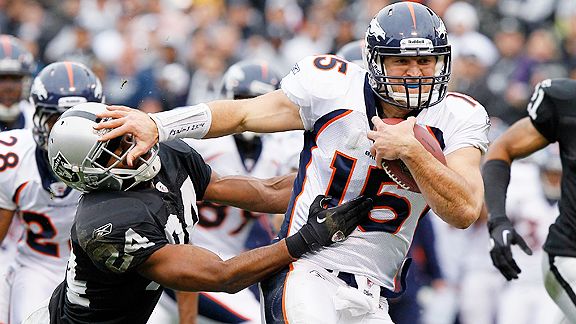
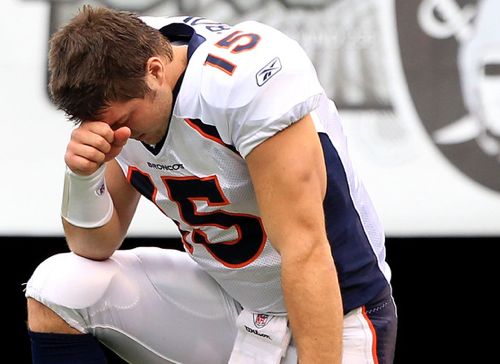
Debunking the myths of Tim Tebow

By Les Carpenter


On a winter day in 2010, Tim Tebow sat alone in a hotel meeting room with Ken Herock, a former NFL general manager who tutors players on how to approach important team meetings at the NFL scouting combine. The topic was a perception among NFL teams that Tebow was successful in college only because of the University of Florida’s offensive system, a notion upheld by the failure of Alex Smith to thrive in the NFL after having played for Tebow’s coach, Urban Meyer, when Meyer was at Utah.

At 7-1 as a starter for the Broncos this season, Tim Tebow is the toast of the NFL world.

“A lot of people are comparing you to Alex Smith because you run the same offense … ” Herock started when Tebow suddenly cut him off.

“Now hold on there, Mr. Herock,” Tebow said. “That’s where the comparisons end. I won the Heisman Trophy. I won a national championship two times.”

He said it not with arrogance, although the words could have been parsed that way, but rather with an assuredness Tebow rarely reveals in his public interviews. It is the kind of thing the Denver Broncos see all the time, the reason many of the team’s assistant coaches have come to love his determination and players faithfully follow him into games they now believe they can win. It’s perhaps why the Broncos are 7-1 since Tebow became the starting quarterback.

“He has a passion about himself, he’s very confident,” Broncos general manager Brian Xanders said.

The temptation is to look at Tebow’s serene smiles in news conferences, watch him shrug shyly at questions about his abilities, listen to him talk about Jesus and think he is a man who plays football simply to spread the word of the Bible. The image is of a marginally skilled player who believes the Lord will slice holes in the defense or find a way to get a receiver open downfield.

And yet inside the Broncos’ complex, conversations about Tebow go on for half an hour without a mention of God or religion or their most famous player’s spirituality. The talk is instead about a man who is driven, who arrives early in the morning and leaves long after most of his teammates have departed. In college Tebow was famous for declarations of hard work but that seemed more about lifting weights and running sprints. Now that he is in the NFL, his diligence is in improving his throwing and studying opponents. The phrase most often attributed to him is not about God but rather, “Tell me how I can get better.”

Want a reason the Broncos are in first place in the AFC West with what amounts to a two-game lead over the Oakland Raiders? It is Tebow’s obsessive preparation.

The hour doesn’t matter. It could be 9 p.m., maybe 10, but at some point every night the phone of Broncos quarterbacks coach Adam Gase will ring and Tim Tebow will be on the line.

“I’ve been watching film,” Tebow will say. Then a string of questions: What happens if a defensive player moves a certain way? How should he go? And what about the receivers? Are there other options?

Quietly, Tebow has dazzled the Broncos coaches with his deep understanding of complex offenses. When he showed up to the team’s suite for his interview with the staff at last year’s combine, he immediately rattled off the principles of his offense at Florida. But then he launched into Norv Turner’s digit system as well as the Patriots’ offense, which the Broncos were also using. The coaches were stunned. How had he learned all this?

Broncos QB coach Adam Gase gets a regular phone call from Tim Tebow, who wants to talk shop.

He watched lots of video at Florida, he told them. While other players went out at night, he loaded films of various offenses in his computer and studied and studied and studied until they were locked in his memory.
“That part of it was very unique to me,” said Gase, who has been with two other NFL teams as an assistant. “I never heard of a college guy who would know so much about offenses outside of college.”

Yes, Herock said, when told about this. He knew.

“I’ll tell you what probably happened,” Herock said. “His agent, Jimmy Sexton, probably told him which teams would want to talk to him at the combine. And he probably said, ‘What kind of questions are they going to ask me?’ Then he went and studied all of their offenses so he knew them really well.”

For instance, when Tebow first appeared at the Senior Bowl amid much criticism over his throwing motion, he shocked the Miami Dolphins coaching staff that had been assigned to coach his team that week by regurgitating their entire offense for them.

“I guarantee you that offense they are running there in Denver now, he put a lot of it in,” Herock said. “I bet he has a lot of input on what they are running up there.”

Because head coach John Fox retained most of the offensive coaches from Josh McDaniels’ staff last year, the Broncos kept the same offense. Inserted in that was the “Tebow Package,” which mostly consisted of option and Wildcat plays best suited to take advantage of Tebow’s running ability. When Fox made Tebow the starting quarterback in October, the offensive coaches took the Tebow Package and made it central to their attack, adding new wrinkles every week. The ease with which they made such an extreme transition from a passing to running team, they said, was because Tebow worked so hard to learn new plays, asking endless questions and suggesting what to add.

“He prepares extremely hard as far as his film study and the time he spends with [offensive coordinator] Mike McCoy,” Gase said. “He’s working every angle that he can. Asking everything. ‘What about my footwork? What about when I am under center? What do I do here?’ ”

Tim Tebow's lowest QB rating as a starter this season happened in Week 8 against the Lions, when he posted a 56.8. His highest QB rating happened against the Vikings in Week 13, when he had a 149.3.
(US Presswire)

Nothing is more important than footwork. This is where the Broncos coaches believe Tebow will thrive next. Last year they left a six-hour, pre-draft visit with the quarterback in Gainesville, Fla., amazed at how he had blown away all other quarterbacks’ scores on a list of qualities they deemed essential. These included: loving the game, competitiveness, leadership, arm strength, understanding offenses, an ability to avoid pass rushes, resilience and composure. They were convinced if they could work on his accuracy and footwork he would come to be seen as a great draft pick.

And so this year it is Gase, who coached receivers last season, spending hours with Tebow on the practice field working on how he steps back from center – something he rarely did at Florida – and throws the ball. For 30 minutes before every practice and 30 minutes afterward, they work on gliding back and stepping forward.

“Everything has to do with his feet,” Gase said. “Before, his body was going in one direction and his arm was going in another direction. As we get him more balanced, his throws become smoother and more accurate.”

What they couldn’t have understood before they drafted him was how much he would practice this. “He’s taken thousands of [extra] reps,” Gase said. When practice turns to defensive drills and the other offensive players rest, Tebow grabs a ball and begins working on his backpedaling, repeating each new technique until it starts to feel natural.

“He’s improved a lot the last few weeks,” Gase said, pointing to throws Tebow made in the Broncos’ last two wins he probably couldn’t have made only a few weeks earlier when the Broncos were merely running an option attack with few passes.

“He’s becoming a much better NFL quarterback,” Fox said. “I think that little variance was to get us to this point. You can’t be one-dimensional in this league. Everybody catches up with that. People are doing different things to stop our running game but they are opening up things in our passing.”

When you talk to Tebow alone, in a back hallway of the Broncos’ practice facility, away from the stampede of cameras that often surround him, you find him to be goofy. It’s not an awkward goofiness, but more of a silliness. He laughs a lot, even when discussing serious things. Third-string quarterback Adam Weber, the man who has a locker next to Tebow’s both at the practice facility and at the stadium, said Tebow is effusive before games, bouncing around the locker room, calling encouragement to teammates in a buildup of energy that seems almost ready to explode onto the field.

“Then he flips a switch,” Gase said.

And Tebow is suddenly calm. Around the Broncos they find this unique, even in a sport where players are required to channel different intensity on and off the field. This, they say, is how he manages to pull the offense together, making some of his best runs and throws late in games.

On Sunday, when the Broncos emerged from their deepest abyss yet in pulling out an overtime victory over the Chicago Bears, Case walked up to Tebow on the sideline and said with a coach’s anxiety, “Why do we have to do it this way every time?”

Tebow smiled tranquilly and said, “We have time.”

“That’s the beauty of him,” Gase said. “There’s a calmness and a composure when the game is tight. He’s smart with the football.”

“I definitely think you have to have an edge,” Tebow said this week as he stood outside the Broncos’ locker room. One of his favorite things to read is a book of quotations put together by a strength and conditioning coach he worked with that contains the words “The Edge” in the title. The coach loaned it to Tebow years ago and the quarterback refuses to return it despite pleas that he does.

“Technically, I stole it,” Tebow said.

It is in this pilfered manuscript where Tebow finds some of his inspiration.

“I think the way that you train should have an edge,” Tebow said. “And the way you work out should have an edge.”

He was asked about the perception that because he speaks so much about his faith and seems so serene on the field that he might not have to prepare diligently. He laughed.

“It’s unfortunate, but a lot of people do think Christians have to be soft,” he said. “But the man we are following is the toughest of all time in Jesus Christ. You have to go through obstacles and adversity. That’s what provides endurance for the future.” Then Tebow paused for a moment.

“God has everything in his hands but he also says, ‘Do unto the Lord with all your heart,’ ” he continued. “Just because you are a Christian, God doesn’t want you … not be the hardest worker. It’s just the opposite. He wants you to work harder.”

And so he does. And so he arrives early in the morning and goes home in the evening with tapes of not just the Broncos’ offense and their opponent’s defense but of players he would like to emulate (“I’ve seen thousands of cuts of Tom Brady,” he said this week). All of it in a diligent preparation to become the quarterback he believes he is. All of it to justify those words spoken on that winter day when asked what he thought of the player who ran the same college offense but had until then been considered a major risk …

“Now hold on there … that’s where the comparisons end … “

Ex-YouTube star dunker finds a home with the Harlem Globetrotters


Ex-YouTube star dunker finds a home with the Harlem Globetrotters
Those attending Harlem Globetrotter games this year will notice a new player that's, well, a little different than the rest of the team.

That's because Jacob Tucker is a 5-foot-10 white guy on a squad known for giant African-American players like its most famous former star, Wilt Chamberlain.

When friends heard Tucker would be part of the team, they almost couldn't believe it.
"Everybody that came up to me, it was a little joke, they always asked if I was on the Washington Generals or the Globetrotters," Tucker said earlier this week in reference to the infamous opponent that has historically served as the Globetrotters' personal doormat.

"I kind of look like the ball boy when I walk into places, and I understand that because not only am I short but I'm pretty young looking still," said the 23-year old. "Whenever I walk into a place with all my teammates that are 6-5, 6-6, I look like the ball boy. But my goal is, whenever all those people leave the arena, they know I'm not."


Tucker will get his first chance to do that the day after Christmas when he debuts with the team at The Palace of Auburn Hills, home to the Detroit Pistons.

It's just the latest turn in Tucker's meteoric rise that started when the then-senior guard at Division III Illinois College and his friends put a video of Tucker using his mind-boggling 50-inch vertical for an array of ridiculous dunks on YouTube last March.


The goal? Gain admission to the college slam dunk contest before Final Four weekend. With his head almost touching the rim on dunks, the clip went viral (it currently has over 4.6 million views on YouTube). It led to national media coverage and Tucker not only competed in the contest, he wowed the judges such as NBA legend Karl Malone and won it.


Not bad for a guy no one had ever heard of nine months ago.

But make no mistake, Tucker was no scrub. Last season he finished second at Illinois College in scoring (14.8 PPG) with plans to become a strength coach after graduation. That's when YouTube propelled him from DIII player to Internet star in the course of just one month. And just when it appeared Tucker's 15 minutes of fame was up after commercial shoots and throwing out the first pitch for the St. Louis Cardinals and Chicago White Sox, the Globetrotters drafted him in June.
Ex-YouTube star dunker finds a home with the Harlem GlobetrottersWith the team's U.S. tour set to begin Dec. 26, Tucker is finally ready for action. He will spend Christmas morning with his family and then fly to Detroit for his debut the following day.
"It's going to be amazing," Tucker said. "I think it's going to be an experience I'll never forget, my first game wearing the Globetrotter uniform. I've been with Slick [former St. John's player Willie Shaw] all day today. All day he's said his most memorable experience was his first game. It's something he never forgot, the atmosphere, the excitement on all the fans' faces."

Speaking from Wisconsin earlier this week while doing publicity for the team, Tucker even sounds more like a ball boy than a pro basketball player with his soft voice and "ah shucks" attitude, saying over and over again that the Globetrotters' goal is for everyone to leave the arena with a smile on their face.
And while some players only use the Globetrotters as a pit stop on the way to what they believe will be a more lucrative career overseas or in the NBA, Tucker intends to play for the Globetrotters "as long as I can." Nicknamed "Hops" on the team's website, Tucker said he is also prepared for a grinding schedule that goes almost year-round and will have him living out of hotels and playing six or seven nights a week.


Though one YouTube clip has changed his life forever, Tucker says he's still the same person he was before he shot to Internet fame and he hopes that comes across in his new job.


"I like to think I'm the exact same person I was a year ago," Tucker said. "And I think that's really important, especially being a Globetrotter now; how you portray that to younger kids, how you handle things with humility and just show them you don't want to give up on your dreams, always have hope and believe in yourself and don't listen when people tell you you can't do something."